A Hundred Years On, the Twenty-Year-Old Sukanta Returns to London
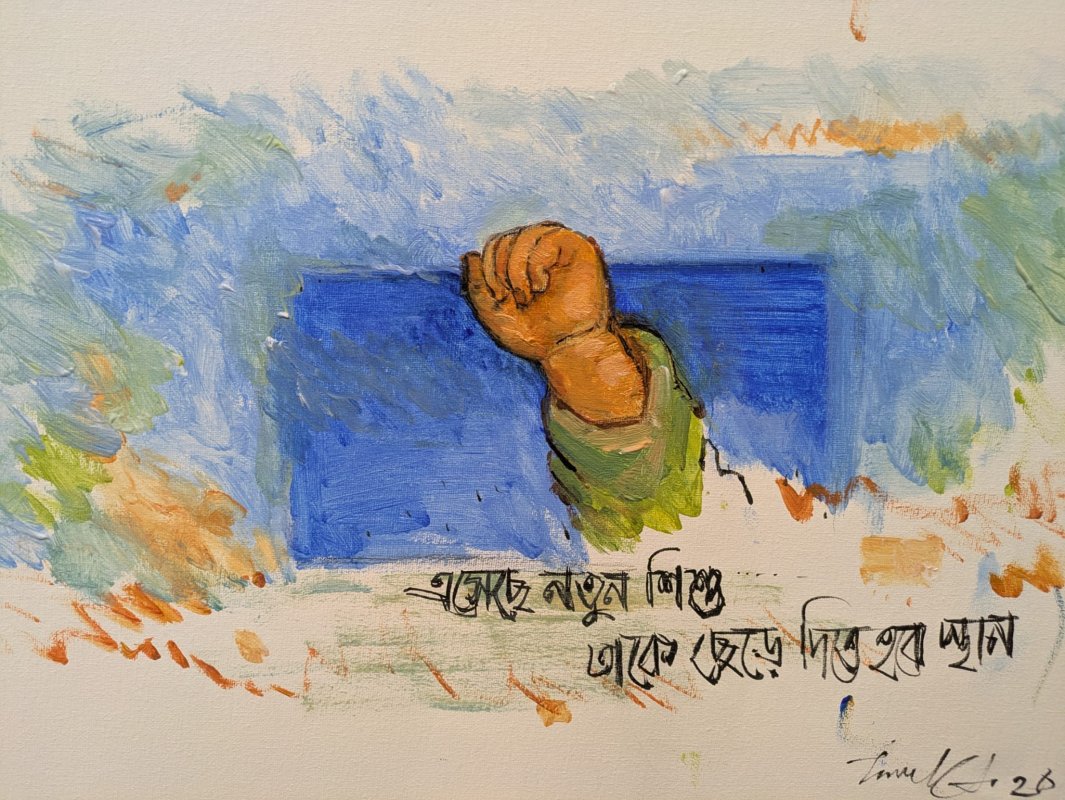
Through song, poetry, dance, discussion and poetry theatre, Sukanta returned to the stage of London's Brady Arts Centre. His poetry travelled beyond Bengali, finding new voices in English, Latvian and Italian. It was six in the evening. The auditorium at the Brady Arts Centre in London was full. Slowly, the lights dimmed, and the stage came alive. And with that light, it seemed, returned a poet born a hundred years ago. A poet who left the world at only twenty: Sukanta Bhattacharya. He returned in song and recitation, in the physical language of dance and in poetry theatre. His words also crossed the boundaries of Bengali, resonating in English, Latvian and Italian. Yet as the evening unfolded, one question grew steadily more insistent: why, a hundred years after his birth, does Sukanta remain so startlingly contemporary?
"In the kingdom of hunger, the world turns prosaic
the full moon resembles a scorched loaf of bread."
In 1944, when Bengal was still reeling from the wounds of a devastating famine, a seventeen-year-old poet wrote these lines. Yet hearing them in London in 2026, one could not help wondering: is this merely history? Or does it also mirror our own world, a world still scarred by hunger, war, inequality, displacement and the continuing struggle for human dignity? In many ways, the entire evening at the Brady Arts Centre became an artistic exploration of that question. The location itself carried particular significance. Tower Hamlets is deeply entwined with the history of Bengali migration to Britain—its struggles, its battles for recognition, and its gradual assertion of cultural identity. At the heart of that cultural geography stands the Brady Arts Centre in Whitechapel, long a familiar home for Bengali music, poetry, theatre and community arts.
Times have changed. Generations have changed. Yet the Bengali cultural journey in London, carrying its language, literature and artistic inheritance, has never ceased. The evening of 27 September became another luminous chapter in that continuing story. Behind the event was Srijon, a newly established cultural organisation in the United Kingdom. In their opening remarks, its President Shahab Ahmed and General Secretary Lenin Haque explained that one of Srijon's central aims is to introduce Bengali language, literature, music, art and heritage to younger generations, while using culture to create meaningful connections between generations. Choosing Sukanta's birth centenary for the organisation's inaugural event seemed, therefore, to define the direction of that journey from the outset.
Sukanta was not presented as a poet imprisoned within a century-old portrait. Performance after performance brought him face to face with the world of 2026. A world in which hunger persists, wars continue, refugees still walk their long roads, and inequality and deprivation remain painfully familiar. Yet it is also a world where protest survives, resistance persists, and human beings continue to dream of building something better. Therefore, Sukanta's poetry crossed the boundary of the past and entered the present. It sometimes felt as though the poet was no longer interrogating his own age, but ours: Has the world really changed so much?
The evening's first response seemed to come through Runner. Sukanta's Runner, the working man who keeps society moving while remaining deprived, raced once more through the darkness of night. Three distinguished London-based singers, Sanjoy Dey, Gouri Choudhury and Laboni Barua, brought the song vividly to life in chorus. The expressive choreography of Monirul Islam Mukul and Niharika Bhowmik complemented their voices. Music, rhythm and movement merged to create a compelling visual poem across the stage. Yet beneath its beauty remained the exhausted footsteps of the Runner. However long the darkness, he must continue running towards dawn. Amit Dey enriched the evening's musical landscape on keyboard, Piyas Barua on tabla, and Harvey Gibbons on cello, while the lighting and sound work of Suna Miah and Samsul Zaki Swapan added dramatic dimension to the performances. Amid this flow of music, poetry and dance, the evening paused to reflect more directly on Sukanta and his times.
Dr Palto Datta raised a fundamental question: how did the Bengal in which Sukanta grew up, marked by colonial rule, the Second World War, famine, poverty and extreme social inequality, shape the making of the poet? In response, poet and fiction writer T. M. Ahmed Kaysher explored the historical and social forces from which this rebellious young poet's voice emerged. Then a question from the young moderator, Ropita, pulled the discussion firmly from history into the present. Does the "hunger" in Sukanta refer only to the Bengal famine of 1943? Or, in today's world, might hunger also mean inequality, lack of opportunity, denial of dignity and social exclusion? The conversation between two generations and two historical moments ultimately returned the question to the audience: Are we reading Sukanta a hundred years later—or is Sukanta's poetry still reading our times?
Before that question had faded, a younger generation took the stage. In the voices of two teenage performers, Cleopatra Pal and Raha Dewan-Syed, Sukanta's Prarthana (Prayer) acquired an extraordinary tenderness. The poet's plea to the sun for a little warmth, a little light, and a little hope for those left cold and deprived seemed, in their voices, to become a prayer from children our age: may the world they inherit be warmer, more humane, and safer. It felt as though humanity itself was quietly passing the responsibility from one generation to another. Today, we seek warmth; tomorrow, we must become the source of warmth for someone else.
One of the evening's most distinctive achievements was its attempt to carry Sukanta beyond Bengali's linguistic boundaries and into a wider human conversation. In the powerful, resonant voice of Dr Bonya Chakraborty, the Bengali words of Deshlai Kathi (The Matchstick) seemed to scatter like sparks across the auditorium. Poet and visual artist Agnese Graudina then read a Latvian translation of the same poem, while writer and poet Giuseppe Mastroianni presented Sukanta's Agneyagiri (Volcano) in Italian. Hearing Sukanta acquire new life through Latvian and Italian voices felt like something more than translation. His anger, protest and hunger for change seemed to cross linguistic frontiers and enter a larger conversation about the human condition. Then hunger returned as one of the most unforgiving realities in Sukanta's poetry. In Laboni Barua's musical rendition of Hey Mahajibon (O Great Life), the full moon ceased to be merely an emblem of beauty. Seen through the eyes of the hungry, it became that unforgettable image instead: a scorched loaf of bread.
Set to music by T. M. Ahmed Kaysher, the poem posed its question anew: what does beauty mean to someone who is starving? When life itself becomes a daily struggle for survival, can poetry remain merely ornamental? That question found an even sharper echo in Gouri Choudhury's rendition of Obak Prithibi (Astonished World). Confronted by a world of hunger, oppression, bloodshed and death, Sukanta's astonishment gradually hardens into anger. Listening to the song on a London stage a century after his birth, another question became unavoidable: has the poet's astonishment at the world really become obsolete? The language of the evening then shifted again. Drawing on Rahad Abir's translation, London performance poet Dr David Lee Morgan presented Durmor in English, evoking the indomitable human spirit that refuses to bow even amid the ruins of war, famine and death.
Sanjoy Dey, meanwhile, performed Durashar Mrityu in his own musical composition, giving emotional depth to the struggle between danger and despair, extinguishing hope and the stubborn will to survive. After so much hunger, war and struggle, the evening suddenly became intensely personal. In Urmi Mazhar's rendition of Priyotomasu, a soldier longs, after war, to return home. The rifle remains in his hand, and the uniform remains on his body, yet all he now desires is home, the person he loves, and the recovery of ordinary life. In that moment, Sukanta's anti-war humanism seemed to remind us of an elemental truth: ultimately, human beings do not yearn for war; they yearn to return home.
From the solitary voice, the stage then expanded into collective utterance, in a specially devised group recitation written and directed by Munira Parvin, a Bangladesh National Award-winning recitation artist and founder of Chhandashik. She was joined by Shatarupa Choudhury, Dr Bonya Chakraborty, Dhananjay Pal, Shah Sharif Uddin and Nazrul Islam Ankib. By bringing the world of war, famine and profound inequality that shaped Sukanta's poetry into conversation with the present, the performance offered a powerful reminder: remembering Sukanta cannot mean merely repeating his words. It also means accepting something of the responsibility those words place upon us in the face of injustice and inhumanity. To remember Sukanta, after all, is not simply to recite his poetry. It is to encounter his dreams, his anger, his human anguish and his profound faith in a world anew yet to come.
That spirit found perhaps its most moving expression in A New World's Passport, a piece of poetry theatre inspired by Sukanta's celebrated poem Chharpatra.
Directed by T. M. Ahmed Kaysher and performed by Sarwar E Alam, Tanushree Guha, Nazia Amin and Asmita Kir, the production combined performance with the haunting sound of Harvey Gibbons's cello and an emotionally charged visual language to create an atmosphere of profound poignancy. Until then, the stage had contained hunger, war, death, deprivation and the fire of protest. At the end, it came to rest before a newborn child. Amid all the surrounding pain and wreckage, the child's arrival appeared like a sudden light in darkness. Against the heartbreaking musical backdrop, its first cry no longer seemed merely the cry of an infant. It felt as though the future itself were breaking through the darkness to demand its rights—the right to live, the right to grow, the right to inherit a humane world. For Sukanta, the birth of a child is never merely the arrival of another life. The child is an emissary of the future, the promise of a new world. And at precisely that moment, the poet's question seemed to leave the stage and stand silently before each of us: What kind of world will we place in the hands of this newborn child?
A hundred years after his birth, Sukanta somehow remains twenty. Born on 15 August 1926 and dead at only twenty, he left behind poetry in which hunger, war, injustice, inequality, protest and the dream of a new world continue, with astonishing immediacy, to speak to our own time. Perhaps that was the greatest achievement of the evening at the Brady: Sukanta was not placed inside a glass case as a centenarian "great poet" to be respectfully commemorated. He was returned to us as he was a young questioner, a rebel, a dreamer. As the programme drew to a close, performers, volunteers and members of the technical team gathered on stage. On behalf of Srijon, Ramya Rahim Chowdhury thanked the artists, sponsors, volunteers, sound and lighting teams, and the Brady Arts Centre for their support.
Eventually, the stage lights went dark. The audience slowly left the Brady and dispersed into the London night. But Sukanta did not seem to leave with them. Somewhere, one could still imagine a Runner racing through the darkness towards dawn. Somewhere, a small Matchstick waits, carrying fire within its fragile body, for the moment when it must ignite. And somewhere, a newborn child raises a clenched fist and looks towards us. Its demand is not extravagant: a world without war, without hunger, without inequality, a world fit for human beings to inhabit. A hundred years later, perhaps Sukanta has left the responsibility for writing that new world's passport in our hands.